
Verification guide – current as of 22 September 2026
Slotozen KYC Australia: Verification Documents and Cashout Checks
 Available in AU
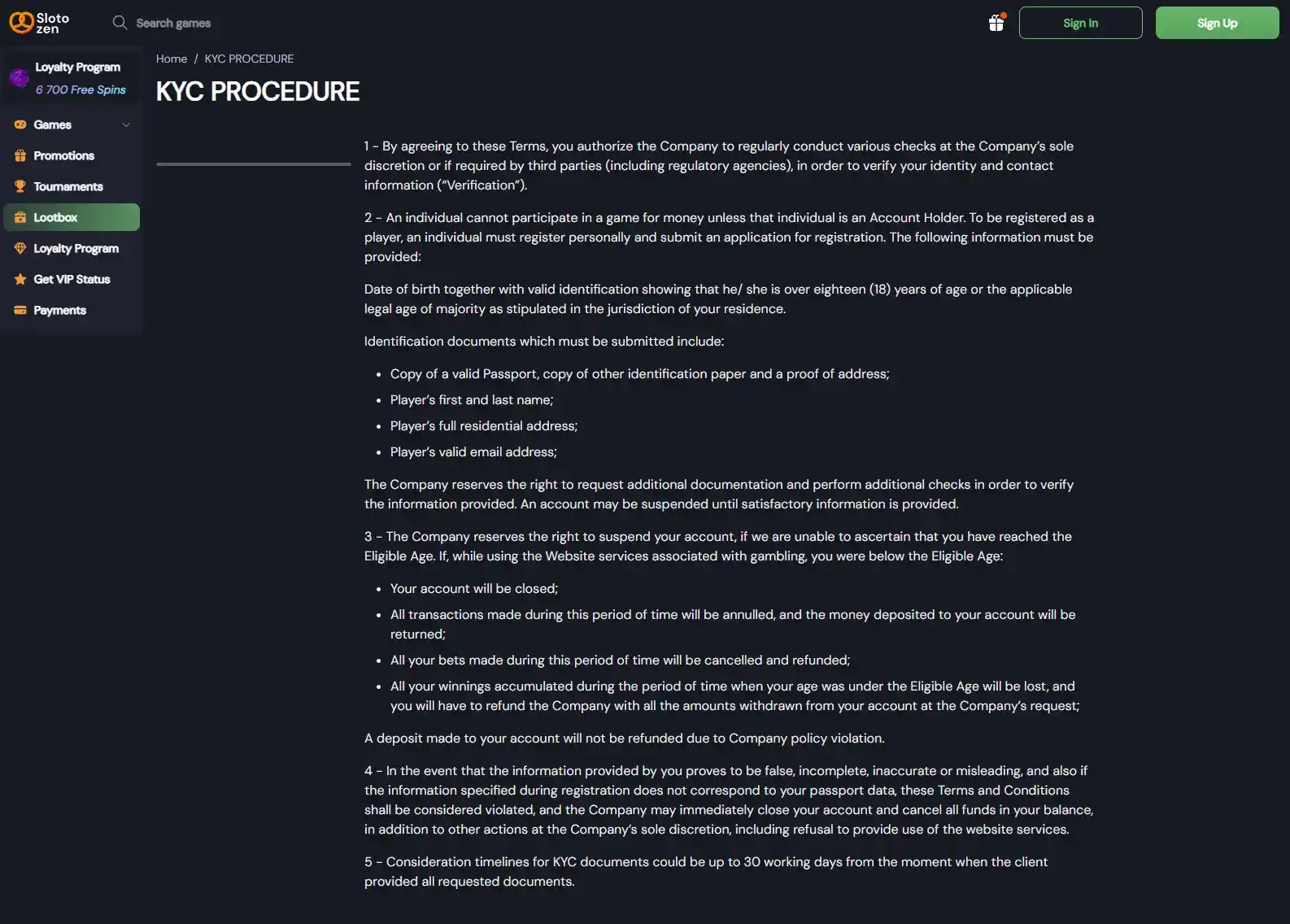
Slotozen can ask for a government-issued photo ID, proof of your current address and evidence for the payment method used on the account. Its current terms also allow extra documentation, phone checks and, in some situations, video verification. Withdrawals can remain pending until the required checks are complete. The current KYC procedure says consideration of KYC documents could take up to 30 working days from the point when all requested documents have been supplied, so that figure should be read as a possible document-review window rather than a normal cashout promise.
For the broader context, see the Slotozen Australia review.
Identity
Photo ID
Address
Current proof
Payments
Ownership evidence
Review window
Up to 30 working days
Slotozen’s separate 72-hour withdrawal processing target applies after approval. A request can stay pending before that stage if verification is incomplete.
Current document categories
Table of Contents
- What Slotozen can ask you to verify
- KYC starts with matching the account to a real person
- Photo ID and proof of address are the two core evidence groups
- Payment-method evidence can become part of a withdrawal check
- Slotozen can escalate verification beyond uploaded documents
- The published KYC window is a ceiling-style review statement, not a standard ETA
- A clean KYC file reduces avoidable cashout friction
- What Slotozen KYC means before your first cashout
What Slotozen can ask you to verify
The official KYC and general terms describe document categories rather than an Australia-only checklist.
| Check | Examples named by Slotozen | What it proves |
|---|---|---|
| Photo identity | Passport, driver’s licence or other government-issued ID | Name, date of birth and identity |
| Residential address | Utility bill or bank statement | Current address linked to the account holder |
| Payment method | Card evidence or e-wallet account image when requested | Control or ownership of the funding route |
| Additional verification | Extra documents, phone call or video verification where required | Resolves identity, payment or fraud-control questions |
The practical workflow
KYC starts with matching the account to a real person
Slotozen’s verification material centres on a simple question: can the operator match the player account, identity details, residential address and payment activity to the same person? The current terms list a government-issued photo ID and proof of address as core evidence, while payment-method proof can be requested when the transaction history needs to be tied back to the account holder.
That means KYC is not just a scan of one document. A clean identity document can still leave an address or payment-ownership question unresolved. The reverse is also true: a bank statement can show an address, but it does not replace the separate photo-ID check.
The most useful preparation is therefore consistency. The legal name, date of birth and address entered during Slotozen registration should match the documents you later upload, and deposits should come from a payment account in your own name.
Photo ID and proof of address are the two core evidence groups
The current Terms and Conditions name a passport and driver’s licence as examples of government-issued photo identification, and the KYC page also refers to valid identification proving the player meets the applicable age requirement. For address evidence, the terms give utility bills and bank statements as examples.
Slotozen also says invalid or mismatched documentation can create problems for the account. That is why an Australian reader should not translate the examples into an invented local list of acceptable documents. A driver’s licence may fit the identity category, but the live KYC request is still the place to check exactly what the operator is asking for at that moment.
Payment-method evidence can become part of a withdrawal check
Slotozen’s terms specifically allow proof of the payment method to be requested. Examples include a card image or an e-wallet account image. The purpose is different from proof of address: the operator is checking whether the payment route connected to the account belongs to the same person.
This matters because Slotozen’s deposit rules require funding from an account, card or e-wallet in the player’s own name. If payment ownership is unclear, a withdrawal can be held while the operator asks for supporting evidence. The detailed payout mechanics, including AUD limits and the 72-hour processing target after approval, stay on the Slotozen withdrawals page.
For KYC planning, the useful takeaway is simpler: keep access to the funding method and its records. Changing payment tools does not erase the possibility that earlier deposit activity will need to be explained or verified.
Slotozen can escalate verification beyond uploaded documents
The current terms allow additional documentation and a phone call when the operator needs more information. They also describe video verification when documents cannot be provided in the requested script, with the player showing identification and stating identifying details. These are escalation tools rather than a statement that every Australian account will go through a phone or video check.
That distinction prevents a common mistake in KYC guides: turning a list of possible checks into a universal checklist. The verified position is that Slotozen can request these additional steps. The exact request depends on the account and the issue being verified.
If an extra check arrives, answer the request that is actually shown in the account or sent through the official support channel. Uploading unrelated documents does not necessarily make verification faster and can create more data for the operator to reconcile.
The published KYC window is a ceiling-style review statement, not a standard ETA
Slotozen’s current KYC page says consideration timelines for KYC documents could be up to 30 working days from the moment the client has provided all requested documents. That is the current official timing statement, but it is not the same as saying every KYC review takes 30 working days or promising a shorter routine turnaround.
It also should not be confused with the separate withdrawal wording. Slotozen says it aims to process withdrawal requests within 72 hours of approval, while actual payout time depends on the method and verification status. KYC can therefore sit before approval in the sequence. A player waiting for verification has not necessarily entered the 72-hour processing stage yet.
Third-party estimates such as a fixed 0-48 hour KYC turnaround are not used here because the official page now supplies its own broader review wording. For planning purposes, treat verification as a dependency that can materially extend the time before a cashout is approved.
A clean KYC file reduces avoidable cashout friction
| Before uploading | Why it matters |
|---|---|
| Check the account name | It should correspond with the identity document |
| Check the address | Address evidence should support the current account details |
| Use a readable full document | Missing or unreadable information can trigger another request |
| Keep payment evidence available | The operator can ask for proof of the card, wallet or other funding route |
| Use official support channels | KYC material contains sensitive personal and financial information |
This is also where the broader trust context matters. Slotozen’s verification process is part of the operator’s own account controls, while Australian regulatory authorisation is a separate question. The Slotozen licence and trust guide documents the operator and licensing evidence, and the Australian casino rules page keeps the ACMA and Interactive Gambling Act context separate from KYC operations.
A useful way to plan the first withdrawal is to separate document readiness from payout timing. If your identity, address and payment ownership can all be matched to the account, there is less chance that the cashout request will pause while another category of evidence is collected. If one of those links is unclear, the published withdrawal target is not the right clock to watch yet because approval can remain dependent on verification. The 30-working-day KYC wording is therefore best treated as a possible review window for a complete requested file, not as a target you should build a normal withdrawal schedule around. Before depositing with a new payment route, keep the same account details and retain access to records that can show ownership if asked. Before withdrawing, check the live request in the account and answer only what is requested. That sequence keeps the identity check, payment check and post-approval withdrawal stage distinct instead of treating them as one process.
Decision guide
What Slotozen KYC means before your first cashout
Before requesting a first cashout, assume Slotozen may need to connect four things: your identity, address, account details and payment ownership. The verified document categories are photo ID, proof of address and payment-method evidence, with extra documentation, phone or video checks possible when needed.
The current KYC page also publishes a potential review window of up to 30 working days once all requested documents have been supplied. That makes early document readiness more useful than relying on an informal fast-verification estimate. If a withdrawal is waiting on KYC, complete the exact request first and treat Slotozen’s separate 72-hour withdrawal processing target as a post-approval stage rather than the start of the verification clock.
On this page
Written by the editors at Slotozen Casino.